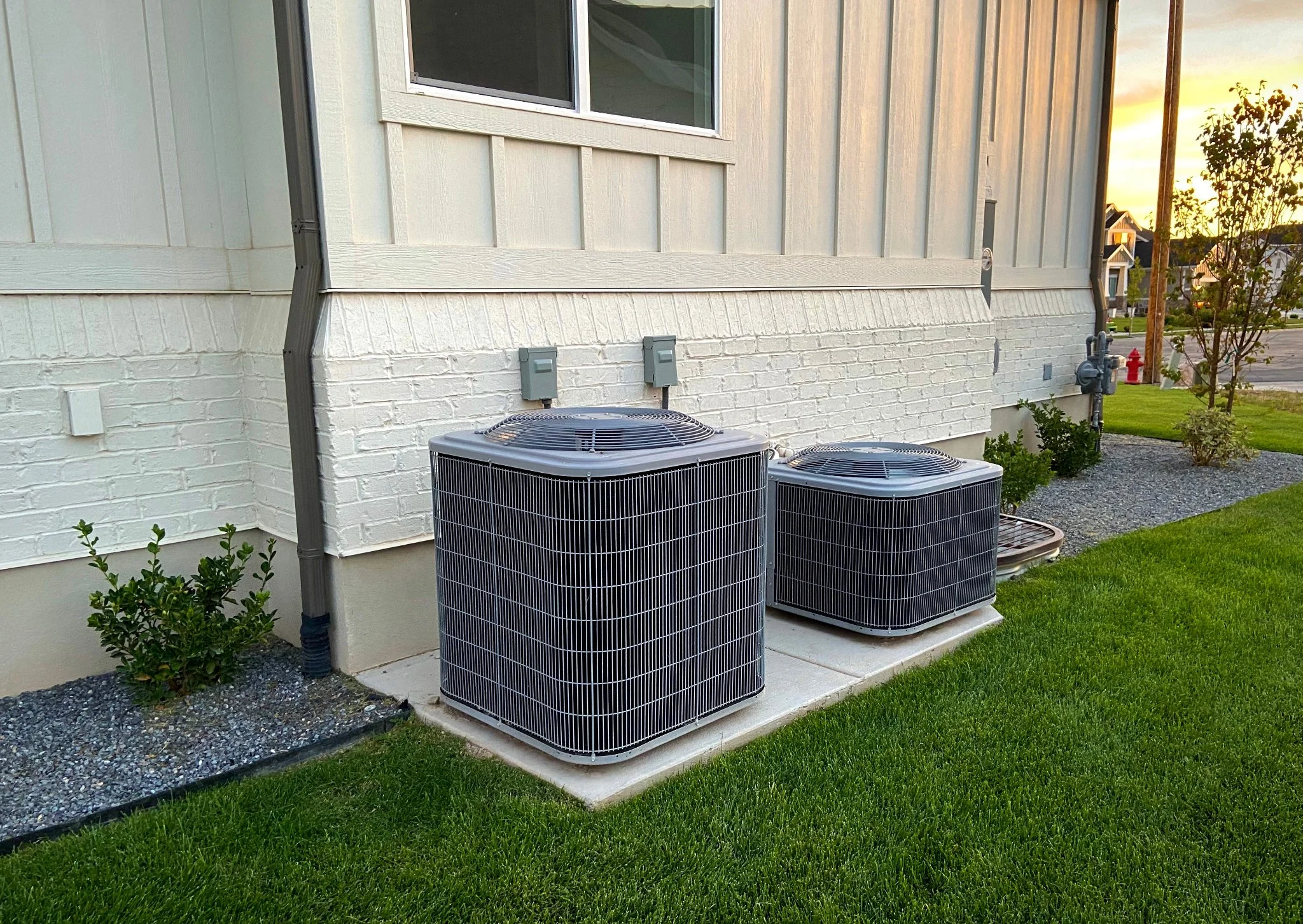
Desert heat, long cooling seasons, and rising energy use in Palm Desert, CA, make the type of AC system as important as the brand on the outdoor unit.
Common AC systems include central air conditioners, ductless mini-splits, window units, portable units, built-in and floor-mounted units, packaged and rooftop systems, geothermal systems, evaporative (swamp) coolers, smart and variable-speed units, and specialized options. Each system type offers unique benefits and is suited to different property needs, climates, and installation scenarios.
Sunlogix serves Palm Desert with heating, cooling, solar, and roofing solutions.
An air conditioner moves heat out of a space, leaving cooler, drier air behind. It also controls humidity and improves air quality. Most electric systems use a refrigerant loop: a compressor, a condenser, an expansion device, and an evaporator. Warm indoor air passes over a cold coil, heat is transferred to the refrigerant, and that heat is rejected outdoors.
A chemical refrigerant absorbs indoor heat, transforms from a liquid to a gas, travels to an outdoor unit, and releases the heat as it turns back into a liquid.
Cooling performance is often expressed as SEER (Seasonal Energy Efficiency Ratio); a higher SEER means the same comfort with less electricity.
Comfort also depends on duct leaks, dirty coils, insulation, window load, whether the roof reflects heat, and a thermostat that does not fight the sun.
Grill design impacts how evenly rooms cool.
Sunlogix treats HVAC, roofing, and solar as one energy ecosystem. Read more on HVAC energy efficiency.
You can sort AC systems three useful ways: how they are installed, who they serve, and what technology they use.
Ducted systems send cooled air through a network of supply and return ducts. Central AC and many packaged units fall under this category.
Ductless systems use refrigerant lines and indoor heads mounted on walls, ceilings, or floors. Mini-splits are the common example.
Self-contained units place most parts in a single cabinet. Window ACs, many portables, PTACs, and some packaged units work this way.
Split systems divide indoor and outdoor components; packaged units keep them together.
Site-built loops, such as geothermal systems, use buried piping and an indoor heat pump.
Homes and businesses do not share the same load pattern. A house in Palm Desert may need quiet nighttime cooling and a few occupied rooms. A restaurant or retail suite may need long run times, kitchen exhaust makeup air, and equipment serviced from a roof.
Residential: central systems, heat pumps, ductless mini-splits, smart thermostats, indoor air quality equipment, and evaporative coolers – designed for smaller, defined spaces.
Commercial: split systems, packaged rooftop units, commercial HVAC services, boilers, water towers, ventilation, and energy management – built for larger areas, complex zoning, heavier continuous use, redundancy, and service access.
Standard vapor-compression AC is the familiar compressor-and-coil design.
Heat pumps reverse that cycle so one outdoor unit can cool and heat.
Evaporative coolers use water and dry outdoor air instead of refrigerant.
Variable-speed compressors ramp output up and down instead of slamming on and off.
Geothermal draws heat from the ground.
Central AC is the most common system in modern American homes: an outdoor condenser and compressor, an indoor evaporator coil and air handler (typically part of a furnace), and ducts to every main room.
A thermostat calls for cooling. The outdoor compressor runs. Refrigerant leaves as a hot, high-pressure gas, sheds heat at the condenser coil, and returns as a cooler liquid. Indoors, that liquid expands and becomes very cold.
The blower pulls house air across the indoor coil, lowers its temperature, and removes moisture.
Supply ducts deliver that air to rooms; return ducts bring warm air back.
The outdoor unit needs clearance for airflow and protection from debris. The indoor coil needs a clean filter. The ducts need to be sized for the blower.
If any of those pieces is wrong, rooms at the end of the run feel warm while the hallway feels icy.
Pros:
Whole-home cooling: consistent temperature control throughout the house; one thermostat can run everything.
Unobtrusive: equipment is largely hidden, with only subtle vents visible.
Air filtration: integrates with whole-home filtration and indoor air quality add-ons in one place.
Dehumidification: strong when the system is sized correctly.
Cons:
Ductwork dependent: costly to install in older homes; attic ducts in a desert climate can gain a lot of heat.
Potential for inefficiency: leaky or poorly designed ducts send cooled air into the attic instead of the living room.
Uniform cooling: a single-zone system cools unused rooms and lacks room-by-room temperature control without additional zoning equipment.
Central air is ideal for new construction and existing homes that already have workable ductwork and a clear outdoor pad. It is a reliable solution for medium- to large-sized homes, open floor plans, and households that want a single system and a single filter.
Ductless mini-splits are a flexible alternative to central air: an outdoor compressor and one or more indoor air-handling units, with no ductwork. They show up often in garage conversions, older homes without ducts, home additions, and rooms that never quite cooled on the main system.
The outdoor unit connects to indoor units via a small conduit that houses the power cable, refrigerant lines, and a condensate drain. Each indoor head has its own fan and setpoint and cools that room or zone directly.
Heads mount on a wall, in a ceiling cassette, or low on a floor.
A single outdoor unit can support multiple indoor units
Most mini-splits are heat pumps, so they heat as well as cool – useful on cool desert nights.
Each indoor unit has its own thermostat, so you can set different temperatures for different rooms and skip unoccupied spaces, such as guest rooms or formal dining areas.
A three-zone heat pump mini-split can treat a living room, a primary bedroom, and an office as three separate spaces.
You are not forcing one thermostat to guess what a west-facing room needs at 4 p.m.
Line sets travel through a small wall penetration, which helps when opening ceilings for new ducts would disturb finished rooms.
The same flexibility helps commercial suites that need after-hours cooling in only one office.
A ductless AC installation is less invasive and faster than installing a ducted system.
Pros:
High energy efficiency: eliminates attic duct losses; many units use inverter (variable-speed) compressors.
Zoned comfort: precise room-by-room control; quiet indoor operation.
Easy installation: faster and less invasive than a ducted system.
Heating and cooling: most mini-splits are heat pumps.
Cons:
Visible indoor units: wall- or ceiling-mounted heads are visible, which some homeowners dislike.
Higher upfront cost per zone: the initial investment can exceed that of a window unit or a single central system if you need multiple zones.
Condensate must drain correctly, or you will see drips. Filters in each head need regular cleaning.
A multi-zone outdoor unit must be sized for the mix of indoor heads, not just the square footage of the house.
Window air conditioners are self-contained units designed to cool a single room. They are among the simplest and most affordable AC systems available.
A window unit contains the compressor, condenser, evaporator, and fans in one compact box. It installs in a window or a custom-made hole in a wall.
The back (condenser) faces outdoors to exhaust heat; the front blows cool air into the room.
These units do not use house ducts. They cool the room they sit in and a little of the hallway if a door stays open.
Pros:
Affordable: low initial purchase price.
Easy to install: most units can be installed by the homeowner without professional help.
Room-specific cooling: effective for small, individual spaces.
Cons:
Noisy: the compressor shares the box with the fan, making them louder than split systems.
Blocks window view: obstructs natural light and window use.
Less efficient: generally less energy-efficient than central or ductless systems.
Security and sealing: can create a potential entry point and a leaky hole if side panels are not sealed.
Window units are a practical solution for renters, apartment dwellers, studios, temporary spaces, or supplementing a central system in a particularly hot room.
They are for small to medium-sized rooms and are not a whole-home strategy for a desert summer.
If several rooms each have a window unit, energy use and noise add up. At that point a mini-split or a small central system usually treats the house more evenly.
Portable air conditioners are self-contained, designed to cool a single room, and sit on the floor on casters. Their main feature is mobility.
The cabinet sits indoors and contains the compressor and both coils. It pulls in warm air, cools some of it, and sends it back into the space.
Heat and moisture vent through a large, flexible hose that runs to a nearby window kit.
Some models use two hoses; many use one. Single-hose designs pull makeup air from the house, which can reduce net cooling.
Pros:
Mobile: can move from room to room as needed – home office by day, bedroom at night.
No permanent installation: easy to set up with no permanent modifications.
Good for renters: useful when window units are not allowed or practical.
Cons:
Inefficient and loud: often the least efficient and noisiest of all AC types.
Bulky: takes up valuable floor space; the exhaust hose is warm and cumbersome.
Requires venting: the window kit leaks if it is sloppy. Moisture collection needs to be emptied unless the unit can drain.
Output is usually modest compared with a properly installed mini-split.
Portable units are a temporary or last-resort solution – rentals where you cannot cut a wall, short-term hot spots, a small office, a server room that needs supplemental cooling, or a room waiting on a permanent system. They are a bridge, not a long-term plan for a whole Palm Desert house.
These systems offer a more permanent, aesthetically pleasing alternative to window units for single-room cooling when a full duct system is not practical.
Also known as through-the-wall units, these install through a dedicated sleeve in an exterior wall. They work like a window AC but do not block a window.
Hotels, additions, and older masonry homes use this layout.
The fit is more secure and airtight than a window installation. Sealing around the sleeve is critical to prevent hot outdoor air from leaking back in.
These ductless indoor units sit low on the wall, similar to a traditional radiator. Air discharge is lower, so furniture layout matters.
A great option for rooms with slanted ceilings, tall windows, limited high-wall space, attics, or sunrooms.
Controls stay within easy reach.
Both designs provide zoned comfort without ductwork and are more integrated, often quieter and more efficient, than window or portable units.
They serve historic windows you do not want to block, or interiors where a high wall head would fight artwork or cabinets.
They still need outdoor heat rejection, a clear airflow path, and a plan for condensate.
Packaged systems contain the compressor, condenser, evaporator, and often the blower in a single outdoor cabinet. Conditioned air is ducted into the building from the unit. They are common in commercial buildings and some residential settings, installed on a concrete slab or on the roof.
Unlike split systems, a packaged unit handles everything from one location. There is no separate indoor furnace coil in many designs.
Sunlogix commercial and residential teams both see packaged equipment, including packaged heat pumps, when a property wants heating and cooling from a single outdoor unit.
Because the equipment is outdoors, it must withstand dust, sun, and monsoon debris. Clearances around the cabinet and a solid pad or curb keep airflow honest.
For commercial buildings in Palm Desert, rooftop units (RTUs) are the standard for retail, offices, and light industrial spaces.
Placing large, heavy equipment on the roof saves ground space, minimizes indoor noise, and allows maintenance without disturbing business operations.
They combine cooling and often gas or electric heat in a curb-mounted box. Economizers can bring in outdoor air when desert evenings cool off.
Roof condition matters. A weak roof, ponding water, or a curb that does not match the new unit results in leaks and service calls.
Sunlogix roofing and HVAC work together, so the curb, flashing, and unit can be planned as a single project.
A PTAC is a through-the-wall packaged system common in hotel rooms and some multifamily buildings. It is self-contained and provides heating and cooling for a single room.
Guests get individual temperature control. Maintenance is unit-by-unit.
PTACs are not a substitute for an engineered central plant in a large office, but they solve room-level control in lodging and similar uses.
Geothermal systems are among the most energy-efficient ways to cool and heat a building. They leverage the earth’s stable temperature to exchange heat. They are less common than air-source equipment in this market, but they belong in a full survey of AC types.
A few feet below the ground, the earth’s temperature remains relatively constant year-round. A ground loop of buried pipes circulates water or an antifreeze solution.
In summer, the indoor heat pump pulls heat from the home and transfers it into the cooler earth.
In winter, the process reverses: the loop extracts heat from the ground to warm the home.
The indoor unit still looks like a heat pump air handler. The outdoor heat exchanger is soil instead of outdoor air.
Because they move heat rather than create it—or work against high outdoor temperatures—geothermal systems are incredibly efficient.
They can reduce energy consumption for cooling by 25–50% compared with conventional systems.
On a 115°F afternoon, an air-source condenser is fighting brutal outdoor conditions. A ground loop is not.
Loop design, soil conditions, and yard or parking lot access determine whether the idea is practical.
Pros:
Extremely high efficiency: very low operating costs and more stable capacity.
Long lifespan: indoor components last 20–25 years; the ground loop can last over 50 years.
Quiet operation: most mechanical components are located indoors.
Cons:
High installation cost: extensive excavation or drilling for the ground loop makes the upfront investment significant.
Land requirement: needs sufficient yard space, or drilling access, plus a contractor who understands both the mechanical room and the buried loop.
For many lots, a high-efficiency air-source heat pump or a well-designed central system is the more direct path.
Evaporative coolers, often called swamp coolers, work on a simple principle: evaporation causes cooling. They are particularly effective in dry climates like Palm Desert.
A swamp cooler pulls hot, dry outdoor air through water-saturated pads. As the water evaporates, it dramatically cools the air, which is then blown into the home.
This process also adds humidity, which can improve comfort in arid environments.
A window or relief opening must stay partially open so humid air can exhaust. There is no refrigerant compressor in a classic swamp cooler.
Evaporative coolers are an excellent, energy-efficient choice for hot, dry regions. They use a fraction of the energy of a traditional air conditioner.
They are ineffective in humid climates – and during monsoon humidity spikes – because the air is already saturated.
Some homes use a swamp cooler during the shoulder seasons and a refrigerated system during the most extreme weeks.
Workshops, garages, and some commercial bays use evaporative units when they need a large volume of fresh air.
Pros:
Very low energy consumption: can use up to 75% less electricity than central AC.
Adds moisture to dry air: improves indoor comfort in arid climates and brings in outdoor air that can feel fresher.
Environmentally friendly: uses water instead of chemical refrigerants.
Cons:
Climate dependent: only effective in low-humidity areas; not a match for tightly sealed homes that cannot relieve air.
Requires water: uses a continuous supply; needs pad changes and seasonal cleaning to prevent mineral scale and odors from building up.
Needs open windows: requires windows to be partially open to allow humid air to exhaust. They also raise indoor humidity.
Modern AC technology has introduced features that significantly boost comfort and efficiency. Sunlogix installs smart thermostats and other advanced devices that can use variable-speed technology.
Smart air conditioners connect to your home’s Wi-Fi so you can control them via a smartphone app.
Adjust the temperature remotely, set schedules, read remote sensors, and monitor energy usage, filter status, and runtime.
Smart thermostats can bring this functionality to many existing HVAC systems by learning your habits to automatically optimize cooling schedules.
That helps when you leave a house closed up during a 110°F day and want it livable before you get home.
Pairing solar production with smarter HVAC control is part of why Sunlogix combines solar and cooling under one company.
Smart controls do not fix a badly sized unit. They make a well-chosen system easier to live with.
Traditional ACs operate on a simple on/off cycle at full blast. Variable-speed (inverter) systems, found in high-end central and ductless units, can precisely adjust compressor and fan speeds.
They run at lower, steadier speeds for longer periods, making tiny adjustments to hold the desired temperature.
Indoor temperatures swing less. Humidity control improves because the coil stays cold longer. Startup spikes drop, and you hear fewer hard kicks from the outdoor unit at night.
By avoiding the constant energy-intensive startups of a single-speed motor, these systems achieve remarkable HVAC energy efficiency.
Long, gentle run times usually use energy more effectively than short, full-blast cycles.
Combined with tight ducts, clean coils, and a realistic setpoint, variable-speed equipment can cut the strain that shows up on summer afternoons.
The goal is to match output to the load instead of oversizing and short-cycling.
Selecting the right system for your property means balancing several key factors. Square footage is only the start.
Home/building size: a proper load calculation is crucial to ensure the system is neither oversized nor undersized. How many stories? How much glass faces west? Are ducts in a scorching attic? Is there a casita, a converted garage, or a room that never cooled?
Climate: the extreme heat of Palm Desert demands a high-efficiency system. Cooling seasons are long and dry, with monsoon humidity spikes – so refrigerated AC, heat pumps, and evaporative coolers all appear in local housing stock. A system that shines in a coastal climate may short-cycle or oversize here.
Efficiency (SEER rating): a higher SEER rating means lower energy bills. Also weigh variable-speed options, controls, roof color, insulation, and shade.
Coverage: a single central unit, a multi-zone mini-split, a packaged heat pump, or a commercial plant each draws a different line around the spaces it serves. Choose the line that matches how you actually use the building.
Central AC cools whole homes through ducts. Ductless mini-splits zone rooms without those ducts. Window and portable units treat one space. Built-in, floor-mounted, packaged, rooftop, and PTAC designs fit walls, pads, and commercial roofs. Geothermal uses the ground. Swamp coolers use dry desert air. Smart, variable-speed devices add control or scale. By considering your property’s size, local climate, and long-term energy goals, you can invest in a system that delivers reliable comfort and efficiency for years to come.

About the Author
Sunlogix
Sunlogix is a family-owned Coachella Valley energy company delivering all-in-one solutions for AC, heating, solar, and roofing. Backed by decades of local experience, Sunlogix helps homeowners and businesses save energy, reduce costs, and stay comfortable year-round.